Tuesday, December 29, 2020

Egwin of Worcester

Today is the Feast of Mary, the Blessed Mother, of Bethlehem. Remember also that January the first, New Year’s Day, is the Feast of Mary Mother of God, a Holy Day of Obligation, get up and sober up you need to get to Church this Friday morning. It is also:


Saint Egwin of Worcester
Also known as
Egwin of Evesham

memorial
30 December

Profile
Our Saint today was descended from nobility and joined the Benedictine order at a very young age. He was elevated to become the Bishop of all of the Shire of Worchester….where the sauce comes from, here in America we pronounce it wooster-sheer sauce, use it when you make hamburgers…it adds a very nice flavor, it is also a principle ingredient in most cheese dishes, particularly Welsh Rabbit, which has no rabbit in it, but I digress….

The Diocese of Worchester needed cleaning up and Egwin did so, but the general opinion was he went a bit too far, and began alienating clergy and religious….he wouldn’t allow ordained deacons to wear appropriate collar and gray shirt at wake services and so forth plus other, less egregious disciplinary items. To give everyone a chance to cool off, and show his repentance for any harm done, he locked his feet in shackles and threw the key into the River Avon. All shackled up like that he made a penitential pilgrimage to Rome. Nice way to get a Roman Holiday on the diocese though, right? Anyhoo, when he got to Rome the key was miraculously found in the belly of a fish he bought in the market.

He founded a Benedictine monastery on the site where the Blessed Mother appeared to a local shepherd, in Evesham, England. I think She told the herdsman she didn’t like sharing her feast day like this……

Born
7th century England

Died
30 December 717 of natural causes

Monday, December 28, 2020

Thomas Beckett


Saint Thomas a Becket

Also known as

 Thomas Beckett

 Thomas of Canterbury


Memorial

29 December


Profile

Our saint is probably the most famous saint from the Middle Ages.  He is also is one of my 13 personal protectors.  Thomas was a deacon but not really too serious about it.    He was educated as a civil and canon lawyer.   His real avocation at the time was to hang out with his drinking buddy, King Henry II of England; Thomas was in the King’s inner circle and even called him by his informal nickname “Hal.”   Eventually Hal named Tom Chancellor of England.


When the position of the Archbishop of Canterbury became vacant, The King figured he could expand his power base over the church by having his pal Tom, appointed to the post.  Back in the day it was common for deacons to be made bishops, even Popes (Sixtus II comes to mind offhand among others).   Deacons were the “Eyes and Ears” of the bishop so they generally knew the inner workings of their diocese so it was a natural succession.       


So this lowly deacon and man’s man was reluctantly ordained on 2 June 1162 as a bishop, and appointed archbishop of Canterbury on 3 June 1162.   Unfortunately for King Hal the Holy Spirit had other plans and Thomas took his vows and new job very very seriously.    He opposed the King's interference in ecclesiastical matters. King Hal was not at all pleased. 


On 29 December 1170 the King muttered “Will no one rid me of this troublesome priest” a man at arms nearby overheard this and took it as an official request.   Tom was murdered after vespers in the Cathedral at Canterbury by a bunch of king’s men.   The area where Tom was offed is marked in the cathedral to this day.


Following Becket's death, the monks prepared his body for burial and discovered that he had worn a hairshirt under his archbishop's garments a sign of penance. 

Not long after, the faithful throughout Europe began venerating Becket as a martyr, and in 1173 barely three years after his death he was canonized by Pope Alexander III.

The following year, July 1174, King Henry humbled himself with public penance at Saint Thomas's tomb in Canterbury as well as at the church of Good Saint Dunstan's.


As an interesting footnote here, my late brother in law, Beek-Bop-o-Roo, was into genealogy.   He was bored one day….So he started looking at The Whip’s family tree.    It turns out she is related to King Edward I of England.   Edward I was the son of King Henry III, who was the son of King John, who was the brother of Richard the Lionhearted, who was the son of King Henry II…the guy who had Tom Beckett killed…..The Whip’s family offed my saint……


Born

21 December 1118 at London, England

Died

murdered on 29 December 1170 in the Cathedral at Canterbury, England

Canonized

21 February 1173 by Pope Alexander III

Patronage

 clergy

 Exeter College Oxford

 Portsmouth, England

 secular clergy

Representation

 archbishop with a wounded head

 archbishop holding an inverted sword

 archbishop kneeling before his murderers

 archbishop being murdered in church

archbishop with a sword through his head

 crosier with a battle-axe head at the top


The excommunication scene from the movie Becket…..I get chills, and a little scared:


Thomas a Becket: Lord Gilbert, Baron of England by the grace of his majesty, King Henry II, seized upon the person of a priest of the Holy Church and unlawfully did hold him in custody. Furthermore, in the presence of Lord Gilbert, and by his command, his men seized upon this priest when he tried to escape and put him to death. This is the sin of murder and sacrilege. In that Lord Gilbert has rendered no act of contrition or repentance, and is at the moment, at liberty in the land, we do, here and now, separate him from the precious body and blood of Christ, and from the society of all Christians. We exclude him from our Holy Mother Church and all her sacraments, in heaven, or on Earth. We declare him excommunicate and anathema. We cast him into the outer darkness. We judge him damned with the devil and his fallen angels and all the reprobate, to eternal fire and everlasting pain! 

[slams candle to the ground]

Monks: [chanting] So be it.


https://www.youtube.com/watch?v=j9efh_EOHqU


Sunday, December 27, 2020

Holy Innocents

Holy Innocents
Memorial

28 December (Roman Catholic; Church of England; Lutheran Church)

the feast is sometimes known as Childermas or Children’s Mass

Profile

This story always upset me as a child and still bothers me as an adult. The evil of Herod and the way life, particularly innocent helpless life, was valued so insignificantly is a crime and a sin of humanity. This Feast is celebrated in The Coventry Carol:

Herod the king in his raging
Set forth upon this day
By his decree, no life spare thee
All children young to slay

This day honors the children slaughtered by Herod the Great when he tried to kill the infant Christ. When Herod realized that he had been deceived by the Magi, he became furious. He ordered the massacre of all the boys in Bethlehem and its vicinity two years old and under, in accordance with the time he had ascertained from the Magi. Then was fulfilled what had been said through Jeremiah the prophet: “A voice was heard in Ramah, sobbing and loud lamentation; Rachel weeping for her children, and she would not be consoled, since they were no more.” - Matthew 2:16-18. They gave their lives, in their innocence, for Christ. They are one of only two non Christian Groups formally honored as saints, the other being the Macabees.

In Spain and Hispanic America, December 28 is a day for pranks, equivalent to April Fool's Day in many countries. Pranks are known as inocentadas and their victims are called inocentes. Various Catholic countries had a tradition (no longer widely observed) of role reversal between children and their adult educators, including boy bishops, perhaps a Christianized version of the Roman annual feast of the Saturnalia (when even slaves played 'masters' for a day). This is also the day when the “King of the Fools’ would have been crowned. In some cultures it is said to be an unlucky day, when no new project should be started.

In addition, there was a medieval custom of refraining where possible from work on the day of the week on which the feast of "Innocents Day" had fallen for the whole of the following year until the next Innocents Day. This was presumably mainly observed by the better-off.

Patronage
babies
children’s choir
choir boys
foundlings
The unborn
The defenseless

Tuesday, December 22, 2020

Glory to God in the highest…


I want to wish you and your loved ones all the blessings of the season. I will remember you all in my prayers as I do throughout the year.

Wow…I was looking at my Christmas post from a year ago. We’ve been through a lot this year. Lots of anxiety, stress and secular problems. In all this, let’s remember, our God became one of us, he will be with us always even to the end of the age. Christ is still king, scripture is still true, and the Eucharist is still real.

“…Suddenly with the angel there was a multitude of the heavenly host praising God and saying: ‘Glory to God in the highest…and on Earth, peace good will toward men.’”

Happy Christmas to all…and to all a good night…..

Monday, December 21, 2020

Ischirione of Alexandria

Saint Ischirione of Alexandria

Also known as
Ischyrion

memorial
22 December

Profile

Our Saint for today was an early Church Martyr during the reign of Emperor Decius and his widespread persecution. Ischirione refused to sacrifice to idols so they Impaled him on a sharp Pole. If they had tried to do the same with a dull German maybe he would have fared better. You bet your dupa; Poles are pretty tough.

Died
c.250 in Alexandria, Egypt

Sunday, December 20, 2020

Peter Canisius


Saint Peter Canisius

Also known as
Hammer of Protestantism
Peter Kanis
Peter Kannees
Peter Kanys
Petrus Canisius
Petrus Kanis
Second Apostle of Germany

memorial
21 December

Profile

Our Saint today was the son of a wealthy burgomeister, or the burgo of a wealthy sonomeister….. He was sent to the best of schools and was an excellent student, studying an eclectic variety of academia, including: art, civil law and theology. He got a degree in Education and a Master’ degree by the age of 19. As you all know the University system, like the Scientific Method was invented by Our Church so back in the day, all the educators in these secular and religious subjects were religious. Peter’s best friends were monks and clerics.

Drawn to learning and education he joined in the Jesuits after attending a retreat conducted by Saint Peter Faber. He traveled and taught throughout Europe at major universities and everywhere. He travelled and worked with Saint Ignatius of Loyola who was his spiritual director, how much better can you do than that…I ask you?

In addition to his university and teaching duties he worked in hospitals and prisons and preached in Germany and Austria. During Mass one day he received a vision of the Sacred Heart of Jesus, and after this vision he offered all his work to the Sacred Heart. He led the Counter-Reformation in Germany, Austria, Bohemia, and Switzerland, and his work led to the return of Catholicism to Germany. He wrote a Catechism for the instruction in the faith of all especially Children. It went through 200 editions during his life, and was translated into 12 languages; in some places catechisms were referred to as Canisi.

He founded colleges, and attended conclaves in the faith, he even spoke at the Council of Trent on the Eucharist. In his travels he was once visiting Fribourg, Switzerland. While there Jolly Old Saint Nicholas, the city’s patron saint, appeared to Our Saint in a vision. Santa told Peter it was time to stop travelling. Canisius did what he was told, he spent the rest of his life there. He died on this date of natural causes; he was interred before the high altar of the Church of Saint Nicholas in Fribourg.

He was proclaimed one of the 36 Doctors of the Church in 1925 by Pope Pius XI. His spiritual director, Ignatius of Loyola, is not…..go figure.

Patronage

Catholic press
Germany
writers of catechisms
Representation
with his catechism and other books
teaching a group of children

Wednesday, December 16, 2020

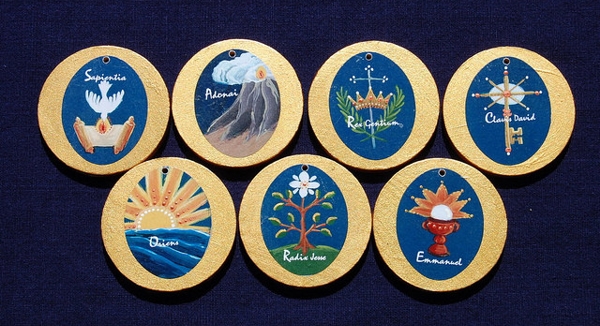
O Antiphons!

 Every year I get real excited when 17 December rolls around because we begin the O Antiphons; Advent is winding down and Christmas is almost here!  

The O Antiphons are the antiphons used during the second half of Advent from 17 December  until 23 December for Vespers (Evening Prayer) in the Divine Office at the Magnificat, and the alleluia verses on the same days for Mass.

They are referred to as the "O Antiphons" because the title of each one begins with the interjection "O".    Each antiphon is a name of Christ, one of his attributes mentioned in Scripture.

·        December 17: O Sapientia (O Wisdom)

·        December 18: O Adonai (O Lord)

·        December 19: O Radix Jesse (O Root of Jesse)

·        December 20: O Clavis David (O Key of David)

·        December 21: O Oriens (O Dayspring)

·        December 22: O Rex Gentium (O King of the nations)

·        December 23: O Emmanuel (O With Us is God)

The first letters of the titles taken backwards form a Latin acrostic of "Ero Cras" which translates to "Tomorrow, I will be [there],” mirroring the theme of the antiphons.